Top MLM Industry Trends & Forecast for 2026

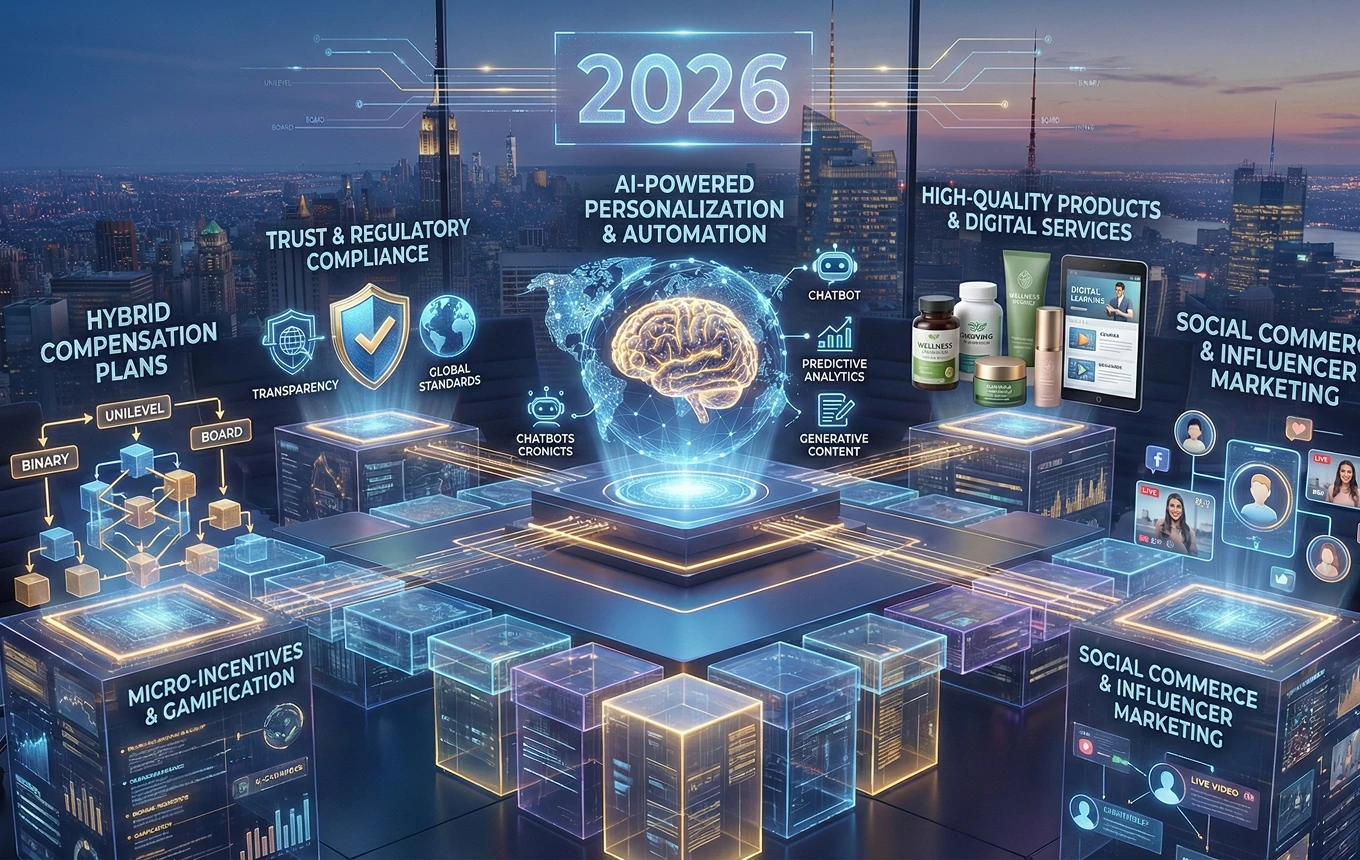
The MLM industry is no longer powered by meetings and manual tracking, it’s driven by data, automation, and smart platforms. As companies race toward digital-first operations, MLM Software has become the backbone of modern network marketing, transforming how distributors sell, recruit, and scale.
With tighter regulations, rapid AI adoption, and mobile commerce reaching maturity, 2026 marks a turning point for the industry. This article explores the evolving business landscape, key innovations, and strategic insights shaping the future of network marketing.
Global MLM Industry Overview (2025 Snapshot)
According to the World Federation of Direct Selling Associations, the direct selling industry generated over $170 billion in global retail sales recently, with consistent year-over-year expansion fueled by digital adoption.
Key insights shaping the landscape:
- Asia-Pacific remains the largest contributor to global revenue, driven by mobile commerce penetration.
- North America leads in technology adoption and compliance-driven innovation.
- Social selling and subscription products are driving stronger distributor retention.
The transition from traditional face-to-face models to digitally enabled ecosystems is one of the most defining direct selling industry trends today. Modern platforms now combine CRM tools, automation, and analytics to support scalable operations and improve managing customer relationships.
Prepare for 2026 Today
Future-proof your MLM business with automation, compliance, and smart platforms.
Top MLM Industry Trends for 2026
The MLM industry is rapidly evolving as technology, compliance, and digital engagement reshape how companies grow. Businesses are moving toward automation-driven operations and customer-focused models. The following trends highlight what will define network marketing success in 2026.
AI-Powered Automation
Artificial intelligence is transforming operational efficiency across MLM software ecosystems by automating repetitive administrative tasks, improving data accuracy, and enabling faster, insight-driven business decisions across distributor networks.
Predictive Performance Analytics
Predictive analytics help leaders identify top performers by evaluating real-time sales data, engagement patterns, recruitment trends, and customer activity to highlight growth potential and optimize team performance strategies.
AI-Driven Distributor Onboarding
AI onboarding tools assist new distributors by delivering guided training experiences, personalized support, automated documentation processes, and instant responses to common queries, helping new members become productive more quickly.
Smart Commission Processing
Smart commission engines reduce payout errors by automatically calculating complex bonus structures, validating network activity, detecting inconsistencies, and ensuring accurate and transparent compensation processing.
Adoption of AI in MLM software is accelerating because companies want automated decision-making, improved operational efficiency, enhanced distributor experiences, and more reliable forecasting to support sustainable business growth.
Rise of Hybrid Selling Models
The modern distributor operates across multiple channels simultaneously, blending personal interaction with digital engagement to reach wider and more targeted audiences.
Key Components of Hybrid Selling:
- Offline Events + Livestream Selling: Combining in-person events with livestream sessions allows distributors to build trust through real-time interaction while expanding reach beyond physical locations.
- Community-Based Messaging Sales: Community-driven selling through messaging platforms enables direct communication, stronger relationships, and consistent engagement with prospects and customers.
- Creator-Driven Promotion: Product promotion through a trusted circle of influencers enhances credibility, strengthens brand visibility, and drives customer interest through authentic recommendations.
This evolution reflects the shift from traditional marketing vs network marketing into a unified hybrid engagement model focused on accessibility, personalization, and continuous interaction.
Mobile-First MLM Platforms
Companies are investing in mobile and field first MLM software to support distributors who manage business activities on the go. Mobile accessibility has become essential for engagement, productivity, and real-time network visibility.
Real-Time Genealogy Tracking
Mobile dashboards provide instant access to downline activity, sales performance, and commission updates, enabling faster decision-making and better team management.
Push Notifications for Engagement
Automated alerts for sales updates, rank achievements, promotions, and training reminders help maintain consistent distributor motivation and participation.
Integrated Mobile App Ecosystems
Flawless mobile app experiences allow distributors to manage contacts, track performance, share product information, and conduct business operations from a single platform.
Mobile accessibility significantly improves onboarding speed and empowers teams to generate high-quality leads directly through social and digital channels.
Compliance & Regulatory Tightening
Governments worldwide are increasing scrutiny on compensation transparency, income claims, and product legitimacy. As a result, companies are strengthening governance practices and implementing structured compliance systems.
Key Regulatory Areas
- Increased Regulatory Oversight: Authorities are enforcing stricter guidelines on compensation structures, distributor claims, and product marketing to ensure ethical business operations and consumer protection.
- Structured Legal Documentation: Organizations are adopting formal compliance frameworks and operational policies inspired by industry best-practice guidelines to reduce risk and maintain transparency.
- Market-Specific Compliance Standards: In regions such as India, regulatory clarity is encouraging companies to follow documented procedures and prioritize retail-driven revenue models for long-term sustainability.
These regulatory changes are pushing MLM companies toward greater transparency and structured operations. Businesses that prioritize compliance and ethical practices will be better positioned for sustainable growth.
Product-Focused Compensation Models
The industry is shifting toward customer-first earning structures where revenue is driven primarily by product value rather than recruitment activity. Subscription commerce, consumable products, and digital service offerings are accelerating this transition.
Modern compensation strategies are designed to support balanced growth, stable distributor income, and sustainable business expansion. These evolving frameworks support sustainability while strengthening long-term MLM success.
Common MLM Plans:
- Binary MLM Plan: The Binary MLM Plan focuses on balanced team growth by structuring distributors into two legs, rewarding performance based on volume distribution and team stability.
- Matrix MLM Plan: The Matrix MLM Plan promotes structured expansion by limiting team width and depth, helping organizations maintain controlled and manageable network growth.
- Unilevel MLM Plan: The Unilevel MLM Plan provides flexible expansion by allowing unlimited frontline recruitment, making it simple to manage and widely adopted by growing networks.
- Stair Step MLM Plan: The Stair Step MLM Plan encourages progressive advancement through defined performance milestones, rewarding distributors as they move up structured leadership levels.
- Gift MLM Plan: The Gift MLM Plan emphasizes peer-to-peer product distribution within a structured participation framework, supporting community-driven engagement.
- Hybrid MLM Plan: The Hybrid MLM Plan combines elements from multiple compensation structures to provide flexibility, scalability, and customized reward distribution for diverse business models.
These evolving frameworks support sustainability while strengthening long-term MLM success.
Expansion into Emerging Niches
The fastest growing MLM niches are driven by changing consumer lifestyles and demand for value-based, repeat-use products. Companies are expanding into sectors that support recurring revenue and long-term customer engagement.
- Wellness & Nutraceuticals Health and wellness products continue to see strong demand as consumers prioritize preventive care, fitness, and everyday well-being. These products often generate repeat purchases, supporting stable distributor income.
- Sustainable & Eco-Friendly ProductsEnvironmentally conscious goods are gaining popularity among consumers seeking natural, ethical, and sustainable alternatives for daily use.
- Digital Education & ServicesOnline courses, coaching programs, and skill-based platforms are creating scalable opportunities with low distribution costs and global reach.
- Subscription-Based Technology SolutionsRecurring service models provide predictable income streams, improved customer retention, and long-term business stability.
Fastest Growing MLM Niches in 2026
Industry expansion is strongly influenced by evolving consumer priorities, digital adoption, and demand for flexible income opportunities. The following sectors are projected to experience significant growth momentum:
- Wellness & Nutrition: Driven by increasing focus on preventive health, immunity support, and lifestyle wellness, this niche benefits from repeat purchases and strong customer retention.
- Beauty & Skincare Personalization: Customized skincare and beauty solutions are gaining traction as consumers seek targeted, results-driven products tailored to individual needs.
- Sustainable Product Ecosystems: Eco-friendly and ethically sourced products are attracting environmentally conscious consumers, creating strong brand loyalty and community-driven promotion.
- Digital Education & SaaS-Based Models: Online learning platforms, business tools, and subscription-based digital services offer scalable distribution with minimal logistical complexity.
- Financial Literacy & Fintech Services: Educational platforms and financial tools are expanding rapidly as more individuals seek income diversification and money management knowledge.
Technology Driving MLM Growth
Technology has become the central growth engine of modern network marketing. Key innovations shaping the industry include:
Cloud Infrastructure for Scalability
Cloud-based MLM platforms allow companies to scale operations without heavy upfront hardware investment. As distributor networks grow, cloud infrastructure dynamically allocates computing resources to handle higher transaction volumes, user traffic, and data storage. This ensures system reliability, faster performance, global accessibility, and reduced downtime, all critical for supporting expanding networks across multiple regions.
Blockchain-Powered MLM Software
Blockchain technology introduces immutable transaction records and decentralized verification into MLM compensation systems. Every commission, bonus, and transaction is recorded on a tamper-resistant ledger, reducing disputes and fraud risks. This transparency builds trust among distributors, simplifies auditing, and strengthens compliance with regulatory standards across different markets.
Automated Commission Processing
Automation eliminates manual calculation errors and significantly reduces administrative workload. Modern MLM systems automatically track sales activity, evaluate compensation plans, and process payouts in real time. This ensures timely payments, increases distributor satisfaction, and allows organizations to focus on strategy and growth rather than operational overhead.
Advanced Analytics Dashboards
Data-driven decision-making is now a competitive advantage in network marketing. Advanced dashboards provide real-time insights into distributor performance, recruitment trends, regional growth, and product demand. Predictive analytics can identify top-performing leaders, detect churn risks, and reveal expansion opportunities, empowering companies to optimize strategy with precision.
Seamless Shopify MLM Integration for E-commerce Expansion
Integration with leading e-commerce platforms enables MLM companies to unify product sales and distributor networks within a single ecosystem. Direct synchronization of orders, customer data, and inventory simplifies operations while allowing distributors to sell products online with minimal technical complexity. This creates a frictionless buying experience and expands global market reach.
Scalable CRM MLM Software for Relationship Management
Customer and distributor relationships are the backbone of network marketing success. CRM-driven MLM platforms centralize communication history, lead tracking, onboarding workflows, and engagement analytics. As networks grow, scalable CRM systems maintain personalized interactions at scale, improve retention, and enhance long-term distributor productivity.
White Label MLM Software for Faster Deployment and Branding Flexibility
White label solutions enable companies to launch customized MLM platforms without building systems from scratch. Organizations can quickly deploy branded software tailored to their compensation plans, workflows, and market positioning. This reduces time-to-market, lowers development costs, and allows businesses to adapt quickly to evolving industry trends. Companies are also investing in White label MLM software to accelerate deployment and branding flexibility.
MLM Software Migration for Global Expansion
As organizations scale internationally, legacy systems often struggle with performance, compliance, or multi-currency operations. Software migration enables businesses to transition to modern platforms that support localization, regulatory compliance, language customization, and cross-border financial processing. Strategic migration ensures operational continuity while unlocking long-term scalability and innovation.
Companies are also investing in White label MLM software to accelerate deployment and branding flexibility. For organizations expanding internationally, MLM software migration is becoming a strategic priority.
Market Forecast for 2026
The global sector is expected to maintain steady expansion driven by digital adoption, regulatory maturity, and evolving consumer demand.
Key indicators shaping growth include:
- Strong expansion in Asia-Pacific and other emerging economies as mobile commerce and digital selling continue to rise.
- Increased adoption of subscription-based business models that provide predictable revenue and stronger customer retention.
- Rising investment in security-focused platforms to ensure transparent transactions, data protection, and regulatory compliance.
- Greater reliance on automation and analytics to improve distributor performance, operational efficiency, and decision-making accuracy.
Overall, the MLM market forecast for 2026 indicates that companies prioritizing transparency, technology integration, and customer-focused strategies will capture the largest share of industry growth.
Challenges MLM Businesses May Face in 2026
Despite growth potential, several structural challenges remain.
- Regulatory Pressure and Legal Compliance Costs: MLM companies face increasing scrutiny around compensation structures, income disclosures, and consumer protection. Meeting compliance standards now requires continuous legal monitoring, transparent reporting systems, and adjustments for different regional regulations — all of which raise operational costs.
- Market Saturation in Traditional Product Categories: Core MLM sectors like wellness, skincare, and nutrition are highly competitive. With many companies offering similar products, standing out requires stronger branding, product innovation, and targeted market positioning to maintain sales momentum.
- Distributor Retention and Engagement Challenges: Recruitment growth alone is no longer sustainable. Many distributors become inactive without structured support. Effective onboarding, continuous training, and performance-based engagement strategies are essential to maintain network productivity and loyalty.
- Public Perception of Recruitment-Focused Models: Negative perceptions around recruitment-heavy approaches continue to affect industry credibility. Companies that clearly prioritize product value, customer satisfaction, and ethical practices are more likely to build long-term trust and brand stability.
- Need for Operational Modernization: To remain competitive, MLM organizations must modernize technology, improve transparency, and adopt data-driven marketing strategies. Simplified operations and professional brand positioning help businesses promote products more effectively in evolving global markets.
Companies must modernize operations to maintain credibility and effectively promote your products and services in competitive markets.
How MLM Companies Should Prepare for 2026?
To successfully expand multi-level marketing business operations, organizations should take strategic steps. Strategic planning also includes evaluating the MLM software pricing guide to ensure cost-efficient technology adoption.
- Invest in Scalable Infrastructure and MLM Software Development: Future-ready MLM organizations need platforms that grow with their networks. Scalable infrastructure ensures reliable performance during rapid expansion, while customized MLM software supports flexible compensation plans, multi-currency operations, and global accessibility.
- Adopt Compliance-First Compensation Structures: Designing compensation plans around regulatory standards helps prevent legal risks and builds distributor trust. Transparent payout logic, clear income disclosures, and audit-ready reporting systems position companies for sustainable international growth.
- Implement AI-Driven Automation Tools: AI-powered tools simplify routine operations such as lead scoring, distributor support, fraud detection, and performance forecasting. Automation reduces administrative burden, improves accuracy, and enables faster data-driven decision-making.
- Strengthen Distributor Training and Support Systems: Well-structured onboarding programs, continuous skill development, and digital support resources improve distributor confidence and retention. Organizations that invest in education and engagement build more productive and loyal networks.
- Build Digital Marketing Frameworks for High-Quality Lead Generation: Modern MLM growth depends on targeted digital outreach. Integrated marketing systems, including content funnels, social selling tools, and analytics-driven campaigns, help attract qualified prospects, thereby generating high-quality leads and improve conversion efficiency.
- Evaluate MLM Software Pricing for Cost-Efficient Technology Adoption: Strategic planning should include a careful review of software pricing models, implementation costs, and long-term scalability. Selecting cost-effective technology ensures sustainable investment while supporting future expansion goals.
Strategic planning also includes evaluating the MLM software pricing guide to ensure cost-efficient technology adoption.
Conclusion
The industry is entering a transformation phase defined by technology integration, regulatory maturity, and customer-focused business models. The most successful companies in 2026 will combine compliance, automation, and product value to build sustainable growth.
The Future of Direct Selling will be shaped by organizations that embrace innovation early, invest in digital infrastructure, and align incentives with real product demand. Businesses that adapt proactively will be best positioned to thrive in the next era of network marketing.
FAQs